
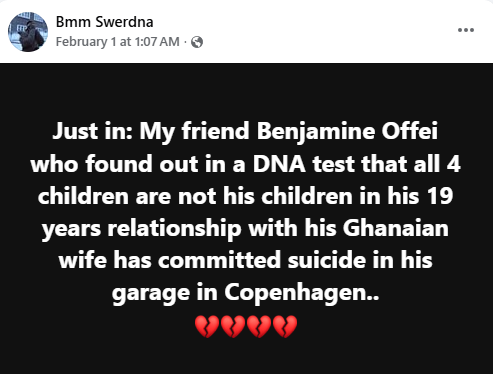
Ghanaian man reportedly commits su!cide in Denmark after DNA tests show he’s not the biological father of his 4 children
Comment


According to reports, the man had lived in Denmark for a significant period, building a life and establishing a family. He was described as a responsible father and husband who invested heavily in the well-being of his wife and four children. However, suspicions or a desire for clarity reportedly led him to undergo DNA testing for the children.
The results were reportedly devastating: the tests indicated a 0% biological probability of paternity for all four children. For a man who had likely poured years of emotional, financial, and physical energy into his family, the revelation was shattering. Unable to cope with the magnitude of the betrayal and the apparent collapse of his life’s work, he reportedly committed suicide.
The Psychological and Cultural WeightWhile the details are specific to this tragic case, the underlying themes resonate deeply, particularly within African and Ghanaian cultures. In many Ghanaian communities, the concept of lineage and “seed” is paramount. A man’s legacy is often viewed through his children. Discovering that one has been childless, despite years of parenting, is not just a biological shock but a cultural and existential erasure.
The psychological trauma of such a discovery—often referred to as “paternity fraud”—is profound. It involves a complex web of emotions: the grief of losing children he still loves but now feels disconnected from, rage toward a partner who deceived him, and shame within the community. The “duped” father often faces a stigma of being naive or cuckolded, which can deter men from seeking the mental health support they desperately need during such a crisis.
This tragedy has ignited fierce debate online. Many have used the story to advocate for mandatory DNA testing at birth or to highlight the silent suffering of men who raise children they did not father. It has become a cautionary tale in some circles, cited as the ultimate reason for “knowing your roots.”However, mental health advocates argue that the focus should shift from the scandal of the DNA test to the tragedy of the suicide. They point out that the pressure on men to be stoic providers, combined with the immense shock of such a betrayal, can create a lethal situation where suicide feels like the only escape.
The death of this man in Denmark underscores a critical issue: the lack of adequate support systems for men facing emotional crises. The isolation of living abroad, far from extended family networks in Ghana, may have exacerbated his feelings of hopelessness.The story serves as a grim reminder of the human cost of deception in relationships. While the legal and moral debates over paternity fraud will continue, the immediate tragedy is the loss of a life—a life that seemingly could not bear the weight of a truth that came too late.


Latest Post!!!
-
 Ikenga worldwide – Carry gurl
-
 Danny S – Ta Ta Ta
-
 Qing Madi – Lady Ft. Tiwa Savage x Flavour
-
Qing Madi – 1 Or 2 Ft. Zlatan x Eemoh
-
Qing Madi – 10 Over 10 Ft. Wande Coal
-
 Boy Spyce – Parousia (Interlude)
-
Boy Spyce – Jonah Ft. Wizard Chan x Kabaka Pyramid
-
Boy Spyce – Problems
-
 Young Legend – Let Me Go Ft. Joeboy x Abefe
-
 Rexxie – Gunners Riddim
-
 Skiibii – Champion Ft. Rybeena x Harmonize
-
 Patoranking – Shake That Ft. Ruger
-
 Tiwa Savage – Energy Ft. Wande Coal x Mavo
-
 Young Jonn – Elumelu
-
 Mavo – Feel Nice
-
 Dj Stunner – Afro Beat Vibes 2026
-
 EMO Grae feat. Zinoleesky – LOL
-
 Balloranking – Kawasaki (Freestyle)
-
 Magnito – Pain Me ft. Original Stereoman (Ekwe)
-
Magnito – Good People
Do you find Music and Gist Hub useful? Click here to give us five stars rating!